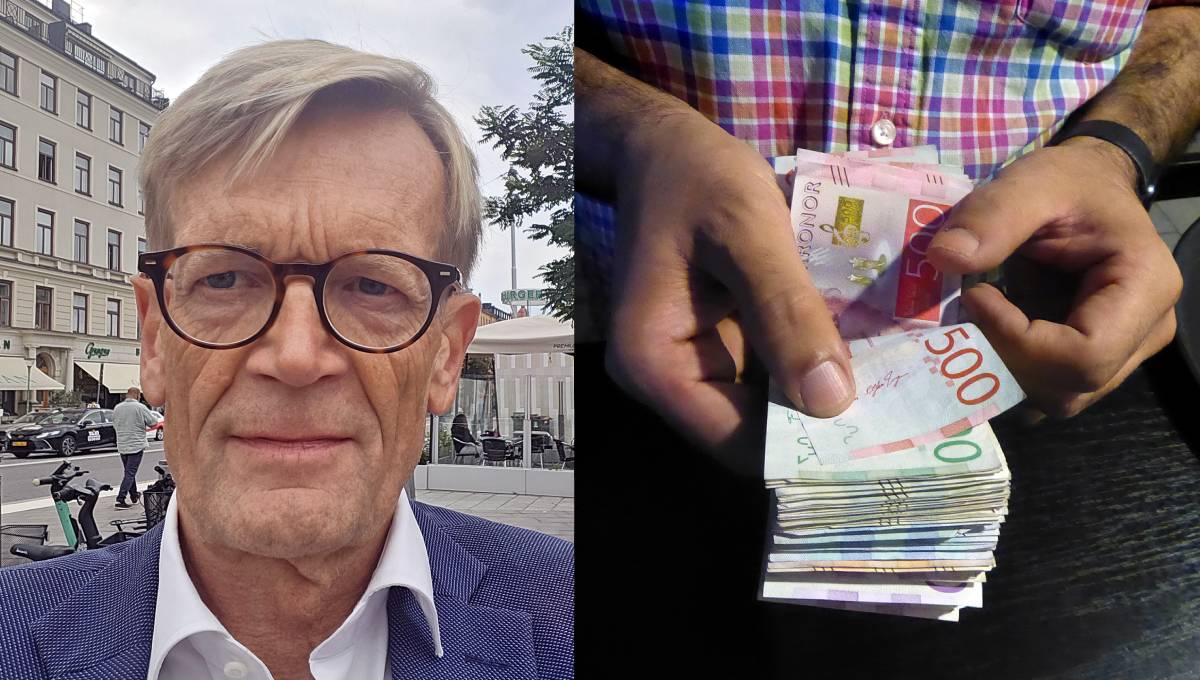
Sweden is stronger with the Swedish krona
Discussions surrounding the re-joining of the Swedish krona to the euro have flared up again. Finance Minister Svantesson recently expressed an intention to investigate joining the euro, but the euro is a stateless currency and therefore not sustainable in the long term. The domestic krona is worth its weight in gold, as evidenced by the strength the krona has shown over the past year. Therefore, Sweden should not join the krona to the euro.
A stateless currency
Since the EU is not a true nation-state, it means that the euro is, in practice, a stateless currency. The 20 members of the EMS (European Monetary System) does indeed share a common responsibility for maintaining the currency through the management of the European Central Bank (ECB).
This works as long as the common interest rate setting works well for all member countries. However, the euro crisis of 2010–2012 – when Greece had enormous difficulties managing its government debt and had to be rescued through bailout packages – shows that the euro has inherent destabilising factors.
The national debt is not consolidated
One of the weaknesses is that member states' public debts are not consolidated. Each member state raises capital independently by issuing its own government bonds to manage its economic policy. Thus, the euro countries have the same short-term interest rate but entirely different long-term interest rate levels because each member state's creditworthiness is assessed individually.
No common capital market
As a consequence, each country has its own capital market, where its own government bonds are traded and the long-term interest rate is set. A common capital market is needed where member states can issue long-term government loans on the same terms and at the same interest rate to ensure common responsibility for the euro's long-term sustainability.
Various banking systems
Nor is there a common banking union, so that the conditions for payments and capital transfers are standardised in the EU. Despite some efforts at harmonisation, different conditions apply in the respective countries' banking systems today. Thus, the banking system in the EU is neither particularly efficient nor sustainable.
No unified tax system
Finally, there is no unified tax system. If the EU is to function as a state, the collection of tax revenue must be standardised through its own tax office. Today, the EU is mainly financed by the willingness of member states to pay their annual EU contributions.
A crown of one's own is worth gold
A currency system that is not fundamentally sound will not survive financial crises. Unlike other currencies, the euro has neither a capital market, a common banking system nor a unified tax authority to fall back on. Consequently, both the euro and the EU are fundamentally fragile. The krona was the strongest currency in 2025, and Sweden is better placed to shape its own future with an independent krona. That is why Ambition Sverige wants to maintain the krona’s independence, not join the euro, but instead leave the EU.
Bo Hansson, spokesperson for the Ambition Sverige party | This article was previously published in Bulletin | Photos: own work (Hansson) and Jonn Leffmann, CC BY 3.0