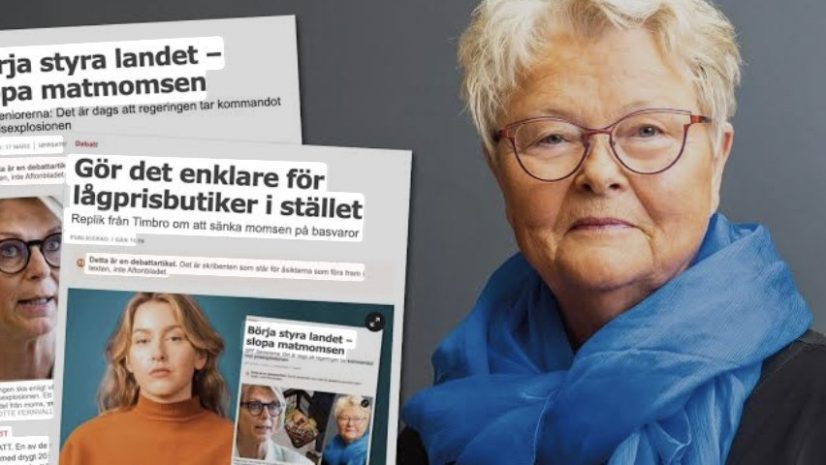
Food or State? How long should we accept starving for politics?
When VAT on food was introduced in 1969, it was to solve an acute crisis in government finances. It was
was intended as a ”temporary” measure in a crisis situation. But like so many others
“temporary” taxes, it stayed. Year after year, government after government, it has been expanded,
defended and normalised.
Today, we pay 12% VAT on the food we buy. That may sound modest. But in
In practice, this means that over SEK 40 billion disappears each year directly from
household coffers, straight into the state's black hole.
For perspective: the state administration thus the bureaucratic apparatus with all
authorities are made up of 367 separate agencies for a country of just 10 million inhabitants.
Bureaucracy costs around SEK 145 billion every year.
By comparison, the Paris region is home to more people than the whole of Sweden, but it does not need
400 authorities to make society work. Yet we still insist on keeping a
oversized machinery that grows every year.
We could have cut down this gigantic machine, cleared away the excess and used
money to something that actually makes a difference: removing VAT on food so people don't have to
go hungry in one of the richest countries in the world. But in Sweden, the prestige of politics and
the self-interest of the state apparatus over the basic needs of citizens.
It doesn't matter that parents can't afford to feed their children or that pensioners
skipping meals. The main thing is that the system gets its due.
Taxes above all. Bureaucracy and the system before people. And when you question
you are told that “there is no room in the budget”.
We have turned the logic on its head: citizens must starve to feed the system
It is as if we have collectively forgotten why VAT was introduced in the first place.
A double tax on people's everyday lives
Think about it for a moment: when you buy food for already taxed money often after paying
some of the highest marginal tax rates in the world, you are forced to pay additional tax/VAT. It is a
double taxation that hits hardest those with the least margins.
For single parents, pensioners and low-income earners, VAT on food is not an abstract
percentage. It is the difference between eating cooked food every day or having to buy it
cheapest rubbish that makes people sick. We are heading towards a class society where some can afford
with nutritious food and health, while others are trapped in poverty and ill health. This gap is growing
for each year.
“Tax expenditure” - a strange word for a tax that should never have existed
When you read the government's budget, it is called a “tax expenditure” that VAT on food is at 12 %
instead of 25 %. In practice, this means that the government counts the missing surcharge as a
lost income as if it were a cost.
Put simply:
- If VAT is increased from 12 % to 25 %, the government will receive around 30 billion extra.
- When you don't get it, it “costs” the state 30 billion.
- This way of counting means that cheaper food is seen as an economic “loss”
while politicians never talk about the bloated budgets of public authorities in the same way.
It does not matter that people are starving or that children go to school hungry. What matters, in
government's logic, is that “net lending” in central government is maintained and that this is done on
at the expense of public health, the state does not care.
Food or rent? Government hunger never ends
For years, households have been squeezed from all sides. Interest rates, electricity prices, rents and food costs
is skyrocketing. More companies are going bankrupt than in decades. Unemployment is on the rise.
Single parents are forced to take out SMS loans to afford the food basket. Older people are skipping out
meals because the pension is not enough.
But in the midst of this, government tax revenues on food are increasing. Because as food becomes more expensive, the
VAT revenue in SEK terms. Did you know that the big food chains in Sweden often have
profit margins of 2-3 per cent, while the government charges 12 per cent on everything? In 2022 alone, the
11.4 billion more than normal, more than the entire grocery sector
total profit.
When your family is forced to choose between rent and food, the government makes more money. It is money that
do not go to you. They disappear into a system that has made itself the number one priority.
When politicians say “we can't afford to remove VAT on food”, what they really mean is: “we don't have
afford to cut back on ourselves.”
There are alternatives:
We can afford it. We just have our priorities wrong. We can do things differently:
- We can remove VAT on basic foodstuffs permanently.
- We can introduce targeted health taxes on sugar, sweets and snacks, which would both strengthen
public health and finance the transition. - We can support co-operative shops, REKO rings and strengthen local communities that want to
challenge the big oligopolies. - We can slim down the oversized state apparatus that grows bigger year after year
while ordinary people are finding it increasingly difficult.
Because the question is not whether we can afford it. The question is whether we want to continue in a system where cheaper food is seen
as an “expense” but the state's own bureaucracy is never called a waste.
It's time to take back the power over food
We are at a crossroads. Either we accept a society where more children grow up in poverty,
more elderly people skip meals and more citizens have to go to social services to ask for help with
food or we say: enough already.
Removing VAT on food reduces the need for benefits. People get back their dignity
and freedom and a sense of empowerment.
Are we to continue fuelling a state apparatus that makes food a class issue, while the state apparatus
swells and ordinary people are pushed deeper into economic insecurity?
Can we afford to accept that the food most basic to our survival is used as a
tools to fill the state's coffers?
Food is not just a commodity. It is a human right. A society that cannot
offer its residents healthy food at reasonable prices has lost its anchorage in what welfare
should mean.
It is time to speak out. It is time to put people first and free people from
the greed of politics.
Elena Malmefeldt (A), spokesperson for the Swedish culture and Health and Wellbeing
Naturopathic Doctor (ND) (Svenska Naturläkarförbundet)