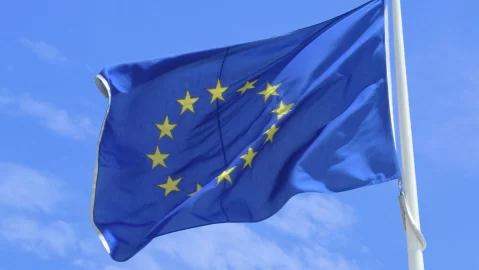
Leave the EU
- Co-operation via trade agreements.

The EU started as a peace project after World War II, but the forces of globalisation have turned it into a supranational bureaucratic machine where decisions are taken behind closed doors and the influence of voters is rapidly shrinking.
Ambition Sverige wants to regain Sweden's sovereignty by requesting withdrawal from the EU colossus. Reclaiming full national sovereignty requires an organised withdrawal that returns all legislative and budgetary competences to the Swedish Parliament. Only then can we design rules and agreements that reflect Swedish values and needs. Sweden can be freed from supranational pressure and introduce direct democratic reforms customised for Sweden.
Only by returning power to the people - giving them the tools to scrutinise, influence and reconsider - can we build a democracy where every vote counts.
Many parliamentary parties today are pinning their hopes on the EU being reformed from within. That this will happen is about as likely as a shark becoming vegan - it won't happen. Today, there is growing dissatisfaction with the EU, far beyond Sweden's borders. One example is the EU's tough environmental policies, which have prompted Dutch, Polish and German farmers to drive hundreds of tractors to Brussels to protest against the Green Deal.
Polish farmers blocked roads to stop costly climate targets. Italian farmers organised tractor convoys towards Rome to demand the suspension of the same Green Deal. Meanwhile, Eastern European countries such as the Czech Republic and Slovakia have blocked their borders to protect domestic farmers.
Why does Ambition Sverige want to leave the EU?
Ambition Sverige (A) believes that Sweden should be a sovereign state. We are not as long as we are in the EU as it stands today. Sweden is a small country with about 10 million inhabitants. Compared to Germany, for example, which has about 85 million inhabitants, Sweden is a tiny country. When the EU Parliament has to decide on a legislative issue, we have a weak voice through our 21 out of a total of 720 members in the EU Parliament. These 21 MEPs can never successfully assert a different view from that of the MEPs from the large countries, so their chances of having an influence are entirely dependent on one or more populous countries thinking like us.
Norway, which is outside the EU, currently pays SEK 10 billion for trade and research agreements with the EU, but is spared most of the climate obligations and other regulations from there. Sweden pays SEK 47.8 billion this year (2025) and is hit by a steady stream of new laws and regulations every year. Of course, Sweden is better governed from home than from the EU. In addition, we need the money (the difference is at least SEK 30 million annually) better at home - for defence, healthcare and elderly care.
How can Sweden leave the EU and with what time horizon?
The Swedish constitution, the Instrument of Government 1:10, states that, Sweden is a member of the European Union. Sweden also participates in international co-operation within the framework of the United Nations and the Council of Europe and in other contexts.
Under the EU Treaty, any member can withdraw from the EU in the following ways
Sweden notifies the European Council by submitting a notification of withdrawal to a Council composed of the Prime Ministers of the Member States. Prior to this (before the notification), negotiations take place and a special agreement is concluded between the European Council and Sweden.
The European Parliament approves by simple majority, after which the European Council decides, i.e. approves, by qualified majority. The applicability of the EU treaties ends when the agreement enters into force.
Alternatively, the EU treaties cease to apply 2 years after Sweden's notification.
For Sweden to be able to notify its withdrawal from the EU, we must have taken a decision at national level to withdraw. This is done by a decision of the Riksdag. Since EU membership is enshrined in the Constitution (the Instrument of Government), the decision to change it must be taken in the manner prescribed for amending the Constitution. To amend a constitution, the Parliament must take two identical decisions and hold a general election between the two decisions.
A legislative amendment to the Constitution is now planned (see Government Bill 2024/25:165), so that in future a 2/3 majority will be required (for parliamentary decision no. 2) to amend the Constitution. The consequence is that it will be very difficult to leave the EU if the government gets its bill through.
A fully-fledged political union
When Sweden joined the EU in 1995, most people probably thought it was a peace and free trade union. We would be able to visit our European neighbours without having to show our passports. For those who read the small print, however, it was obvious that it would be a full-fledged political union, including common foreign and agricultural policies. The risk that we would have a common superstate whose decisions and legal acts would take precedence over our own parliament and our own laws was clear.
The EU is swelling beyond all reason
Today, the EU can best be characterised as a bureaucratic colossus that has become an end in itself and a feeding ground for its own staff. The Commission consists of one representative from each member state (27 countries), plus a President. None of them is elected by the people. Their job is explicitly to promote the EU's interests, not those of its member countries. One way they do this is by producing a flood of new laws and rules every year that shift more power from member countries to the EU. The EU has tens of thousands of staff whose job is basically to make laws. It is their job and their bread and butter. The recipients of these papers and reports are obviously at a complete disadvantage because they have other tasks to do than just commenting on/negotiating legal texts. The principle of subsidiarity enshrined in the EU Treaty has been completely disregarded.
The Free Trade Union became a bureaucratic union
In a free trade area, only the sellers and buyers decide what is traded. The EU's bureaucratic union is different. There, sellers and buyers must first and foremost fulfil the EU's regulatory burden. It favours big businesses that can afford EU compliance specialists, but penalises smaller companies. This leads to high prices and makes us all poorer. Bureaucracy stifles business and drives many companies out of business, while others relocate to friendlier countries outside Europe. No member state is allowed to use its own rules to favour its own clients. The result? Since 1991, the EU's share of global GDP has almost halved from 28% to less than 15%.
The peace union became a war union
Without its own foreign policy, Sweden is no longer able to decide who is friend or foe. We are automatically drawn into the EU's trade wars and boycotts. Outside the EU, we would be free to choose whether we wanted to resolve conflicts with war or with traditional Swedish diplomacy and trade.
The EU started out as an organisation for free trade and free movement between countries. Now, EU defence spending has increased significantly. The European Commission plans to boost defence with an additional €800 billion (”Readiness 2030”), to be collected from member states over four years to be used by a future war-fighting organisation.
As usual, Sweden is likely to follow the majority, as it did when Mr Löfven and the Members of Parliament agreed to pay over €16 billion for COVID-19 injections for the Swedish population. The total amount approved then was €750 billion. A similar decision is now planned for €800 billion.
An important question is whether we will also be jointly and severally liable for the debts of other EU countries? What will happen the day we cannot pay and risk the collapse of our welfare system? What political conditions will be imposed on Sweden on that day?
... and an immigration, carbon, energy, censorship and fiscal union
The EU is taking over more and more policy areas. Areas that we never voted on. The trend is towards replacing nation states with a bureaucratic EU state on the old Soviet model. Through various ”funds” for covid, for armament, fees for carbon emissions, penalties and the ever-growing membership fees, the EU is gradually moving towards taxing the citizens of the Union.
The common external border (Schengen) was replaced by mandatory immigration quotas. When Sweden needs technical expertise from faraway countries, we can actually solve it without the EU's help.
Sweden is Europe's largest net exporter of electrical energy. The EU is forcing us to make 70 per cent of our transmission capacity available for export, which is driving up electricity prices for us Swedes.
Now the EU is also trying to take control of forests, as it has done with agriculture.
Free speech is being abolished via the Digital Services Act (DSA), a law to censor information on the internet that the EU dislikes. The solemn declarations of EU values have turned out to be little more than a censorship, control and surveillance state with totalitarian ambitions.
All memberships must be constantly evaluated
History shows that co-operation, and especially unions, tend to become permanent. They acquire their own officials and form their own political level. Supranational cooperation must therefore be constantly evaluated. When they no longer benefit citizens, but only special interests and their own staff - then we should leave them. That is where we are today. Parkinson's laws could not be more clearly illustrated.
Ambition Sverige wants to learn from direct democracies
Instead of closed corridors and representative distance, a number of countries are showing how citizen participation can work. Ambition Sverige wants to see a clear shift to more direct democracy.
- Switzerland (non-EU) - With over 327 federal referendums since 1848, Switzerland is a prime example of continuous citizen participation. The right of initiative, which requires 100,000 signatures for constitutional amendments or 50,000 for bills, gives civil society powerful tools to push issues regardless of party affiliation. An average turnout of 50 % in these votes means that politics is never further from the people than a single initiative. The system creates accountability, as every politician knows that all laws can be directly challenged by citizens, and that broad public opinion is necessary for sustainable reform.
- Liechtenstein (non-EU) - With only 1,500 signatures (out of approximately 35,000 eligible voters), citizens can stage a national referendum. In addition, residents have the right to recall specific members of parliament if 30 % of voters demand it. This system puts strong and democratic pressure on potentially powerful politicians - forcing them to stay in touch with voters' everyday concerns. The Liechtenstein concept shows how low thresholds and recall rights can be used to counter corruption and elite-driven agendas.
- Uruguay - Optional referendums and constitutional referendums have been held here since 1917, with a turnout of 80-90 %. By regularly asking key questions on issues ranging from social reform to security policy, Uruguay has created a culture where political participation is the norm rather than the exception. High voter turnout gives decisions strong legitimacy and builds shared values. The country shows that extensive direct democracy can work alongside representative government without leading to chaos or decision paralysis.
Ambition Sverige will work for:
- That Sweden leaves the EU as soon as possible. Under current rules, Sweden can leave the EU at the earliest during the 2030-2034 parliamentary term. This requires the Riksdag to vote in favour of an exit before the end of the next parliamentary term in 2030 at the latest, and to vote again in favour of an exit at the beginning of the following parliamentary term, 2030-2034.
- That Sweden should endeavour to be part of the EU's trade union on the day we leave the EU, and seek new cooperation that facilitates free trade.
- EU membership should be removed from the Constitution to make it easier to leave once the decision to leave the EU has been taken.
- That Sweden should not adopt the euro as its currency. The euro has no advantages for us, it would only take away our ability to conduct our own monetary policy and thus the ability to control interest rates and inflation.
- That as long as Sweden is a member of the EU, we will work to take back political and legislative power from the EU in energy, environment, agriculture, forestry and health policy. As a sovereign state, we should have the right to promote our own interests.
- Demanding a sharply reduced membership fee and ensuring that it matches the contributions we receive back. We should not remain one of the Union's biggest net contributors.
- Saying no to all forms of punitive taxation by the EU. It is a voluntary association.
- Saying no to EU emissions trading. We should decide on our emissions ourselves.
- Saying no to all forms of EU taxation, both open and camouflaged in various funds for covid, armament and carbon emissions.
- Taking back control of our borders and of immigration.
- Not participating in the EU's so-called talent pool, which is a euphemism for forced immigration.
- Work to retain the right of veto in the European Council on foreign and security policy issues, as well as on other issues where the right of veto still applies. This will prevent us from being overruled on vital issues.
- Being favourable to other countries that are considering leaving. The more countries that choose to leave the EU, the easier it will be for us.