In her summer talk, Elsa Widding, leader of the Ambition Sverige party, delivers a scathing critique of Swedish security and foreign policy, the EU’s influence and the political debate in the Riksdag. She describes how Sweden risks being drawn into a major war with Russia and argues that the government and the Riksdag have capitulated to supranational agendas.
Elsa Widding begins with a brief personal note. She refers to previous summer programmes where she spoke about her husband's death from cancer and her time with her sons, but states that hope for her family is now gone. She speaks of a long-standing grief over the estrangement of her adult children and believes more people need to dare to talk about it. She then moves on to politics.
She describes her path into the debate after the books The climate carousel (2019) and Common sense on energy and climate (2022) as well as YouTube films. The topics have broadened from climate and energy to freedom of expression, Covid, geopolitics and the power of supranational organisations. She believes that censorship is increasing and that freedom of expression is being eroded in Sweden.
Criticism of the EU and supranationalism
Widding argues that Sweden is gradually implementing EU legislation that reduces national self-determination. She describes the EU as a socialist project where decisions are made behind closed doors and voters' influence is shrinking. Agenda 2030 is described as a driving force behind the government's and parliament's actions, along with the UN, WHO, and World Economic Forum. She claims that power over Sweden has been taken out of the people's hands for the benefit of these organisations.
Security policy and the risk of war
The bulk of the discussion is dedicated to security policy. Widding criticises The DCA agreement with the USA, which she claims means that Sweden has relinquished territorial sovereignty. The USA has the right to use 17 large bases and areas, potentially install nuclear weapons and wage war from Swedish territory – something she believes will provoke Russia.
She views the war in Ukraine as a proxy war in which Sweden and NATO are escalating the conflict in a way that risks dragging Sweden into it. She points to corruption in Ukraine (citing figures in the tens of billions of dollars), previous peace efforts in 2022 which she claims the West thwarted, and the fact that Russia views NATO’s expansion as an existential threat.
According to Widding, the government and NATO are mistakenly believing that Russia will remain inactive while the West re-arms until 2030.
Minister of Defence Pål Jonsson, Foreign Minister Maria Malmer Stenergard, and the Prime Minister Ulf Kristersson called ”jelly rats” who give in to the defence industry, vaccine industry and excessive climate policy.
She warns parents of soldiers, especially elite soldiers, amphibious soldiers and units that can be deployed in the Baltics or Finland, as the risk of war is imminent. The government has been granted the mandate to send soldiers without parliamentary approval, which she views as serious.
Widding quotes herself from a parliamentary debate: If Swedish sons fall in a NATO-Russia war, the government will have their blood on its hands. She urges soldiers not to trust politicians.
Democracy, party discipline and migration
She harshly criticises parliament's working methods. Members are described as ”clueless button-pushers” who are controlled by party and group leaderships, which in turn are controlled by the EU and other international bodies. Speaker Andreas Norlén receives criticism for maintaining the facade of democracy and for expensive private flights at the taxpayer's expense.
The offset debate in spring 2026 is highlighted as an example of how the system works – or doesn't work.
Regarding the Sweden Democrats, she says the party abandoned its ideology for power: they have accepted EU supranationalism, climate goals, WHO health policy, CBDC, and warmongering against Russia. Migration policy, according to her, has not delivered, despite higher demands for citizenship, many new citizenships and residence permits were granted.
Ambition Sverige wants a pause in immigration, focus on self-sufficiency, order and control of exclusion areas, and a census.
Sweden as an alternative
Widding presents her party as the voice of the people for common sense and a free, sovereign Sweden without coercive agendas. The party will consist of experts in various fields. She urges listeners to read the party platform at Ambitionssverige.se, to help with ballot papers, and to realise that time is short before the 2026 election.
”As you make your bed, so you must lie in it.”, "she says to those who vote for the established parties. She concludes by hoping she is wrong about the risk of war, but believes the government is gambling with Sweden's security and that diplomacy with Russia would be preferable.".
Transcription, photo and summary: Torbjörn Sassersson
The war in Iran is slowly but surely creeping closer to Europe. An English airbase in Cyprus has been attacked by Iran. The question is what happens if Iran launches a ballistic missile at Ramstein in Germany, the USA's largest airbase in Europe? Germany could then invoke Article 5, which states that an attack on one NATO country is also an attack on all member countries of the organisation.
Given Sweden's ambition to always be ”best in class”, it is not entirely unthinkable that selected Swedish units would be dispatched to the conflict zone in this situation. Suddenly, Sweden is involved in a world war.
Government Bill 2025/26:6 is a clear decision-making framework for NATO's collective deterrence and defence activities, which the Riksdag voted through last autumn and which came into effect on 1 December 2025, making it now easier to deploy Swedish military forces, with no further approval needed from the Riksdag.
The government may deploy Swedish armed forces within the framework of NATO's deterrence and defence in the event of an armed attack against a NATO ally. Furthermore, there is the possibility of further deployment of a limited-sized armed force for a limited period if a delay would cause considerable detriment to pressing Swedish interests or if the need arises at short notice.
This means that in urgent and unforeseen situations, the government can decide on a limited deployment without prior parliamentary approval.
There is no requirement for a ceasefire or peace settlement for a military operation within the framework of NATO's deterrence and defence activities to be realised.
Two hundred years of successful non-alignment are now a thing of the past.
The war in Iran is about what?
The media are discussing various reasons for what led to the war in Iran, where the US chose to attack the country. It has been about Iran's uranium enrichment, the abhorrent and misogynistic regime, or Israel's dreams of ”Greater Israel. America's will to safeguard the petrodollar is rarely mentioned as a reason for the attacks, but as long as oil is only traded in dollars, America can finance its enormous national debt.
Almost all countries that trade oil require vast amounts of US dollars, and the US can therefore get a market for its government bonds to finance its rapidly growing national debt. Should the petrodollar fall, meaning an increasing number of countries stop trading oil in dollars, US public finances risk being significantly weakened.
Experts today point to recurring patterns. The countries that the USA attacks have in common that they have not wanted to align themselves with the petrodollar system, but instead have chosen to sell their oil in other currencies. This happened in Iraq, Libya, Syria, and most recently in Venezuela. The oppressive regime in Iran has also not wanted to align itself with the petrodollar system.
Who started the war in Iran?
The negotiations concerning Iran's nuclear activities, which took place around the time of the US attack a couple of weeks ago, progressed positively, with Iran, according to former CIA analyst Larry Johnson among others, not opposing the key points.
Iran was attacked by the USA during ongoing negotiations, which also happened during the ”Twelve-Day War” in 2025. This time, Iran was attacked by a massive air raid which, among other things, killed Iran's Supreme Leader Khamenei and the country's highest military and political leadership. This war of aggression has met with strong protests around the world and not least within the USA, where only one in four Americans support the war.
The decision to start the war also did not follow the US constitution's order, which stipulates that only Congress can declare war. In this case, it was Trump himself who ordered the attacks. Bill Clinton has expressed himself very critically about the constitution being overridden, but also Norway's Minister of Foreign Affairs, Bert Eide, sharply criticises the US and Israel's decision to attack Iran when interviewed on SVT, 30 minutes: ”disliking a regime is not enough,” he says.
Could Iran be bombed into submission?
Beyond provoking a regime change in Iran, the US and Israel's strategy with the war is unclear. Whether the plan, whatever it may be, will succeed remains to be seen, but the death toll among innocent people will likely be in the hundreds of thousands and the desire to acquire nuclear weapons will rather increase, as Ayatollah Ali Khamenei is said to have been against nuclear weapons.
The new leader, Mojtaba Khamenei, has seen his father Ayatollah Ali Khamenei murdered by the USA, as well as his wife, son, daughter, and mother. The regime in Iran developing in a more democratic direction whilst fighting for its survival does not currently feel realistic.
What does the Iranian resistance look like?
Until today, Iran has defended itself against Israel and most US bases in the region with drone and missile attacks. All countries that have long been under US protection in the region are now also being attacked by Iran.
It is not only US bases that have been attacked, but also oil infrastructure in the United Arab Emirates, Bahrain, Oman and Qatar. Iran has also closed the Strait of Hormuz, through which 20% of the world’s oil previously passed and the bulk of food supplies to the Gulf states entered.
Iran also possesses hypersonic missiles that pose a significant threat to US warships in the area. Aircraft carriers, which are the backbone of the US war machine, are of particular concern.
Can the US presence in the area be questioned?
A significant number of Iran's drones and missiles have penetrated Israel's and the USA's air defence, leading to extensive damage and even the deaths of Americans and Israelis.
The American presence has led to several countries in the region that are currently under American protection now being involuntarily attacked and drawn into the war.
It is therefore not impossible that the war could lead to major changes in the US presence in the region, where the US finds it increasingly difficult to convince the Gulf states why they should be under American protection.
Will Sweden be safer with an American presence on Swedish bases?
The war now casts a completely new light on Sweden's NATO membership. How much can we rely on US protection? Is there a risk that things will go for Sweden as they did for the Gulf states, when these states are now being bombed as a direct consequence of the US using their territory for its war of aggression against Iran?
The current and previous Swedish governments have acted in a way that maximises the risk of war for the Swedish population. Sweden has joined NATO and entered into a DCA agreement with the USA, which, similarly to the Gulf states, grants the USA access to our military bases and training areas.
Sweden has been one of the most ardent cheerleaders of the Ukraine war, and Defence Minister Pål Jonson and the government have allowed Swedish territory to be used as a staging area for NATO troops in a potential war against Russia. A liaison staff, NATO Force Integration Unit (NFIU) has been established in Enköping.
The government's and parliament's foremost task is to ensure the security of their own population. Here, the government and parliament receive the worst possible rating as they are now on the verge of dragging the country into a deadly world war.
Elsa Widding and Ulf Gabrielsson | Image: Official inauguration with NATO Secretary General Mark Rutte, Belgian Prime Minister Bart De Wever, Belgian Defence Minister Theo Francken, and Belgian Deputy Prime Minister David Clarinval | Pressphoto: NATO.int
In the recent interpellation debate with Elsa Widding, Defence Minister Pål Jonson said that ”over 80% of the Ukrainian people want to continue this fight according to the polls available”, But a July 2025 Gallup poll shows that only 24% of the population want the war to continue. A full 67 % want a negotiated peace.
In other words, this means that the Minister of Defence is riding roughshod over the Ukrainian people when he advocates continuing the war effort.
European leaders have reached a deadlock
Mr Jonson also supports the European leaders' negotiating proposal based on the return of all occupied territory to Ukraine, which after the end of the war will have a military force of 800,000 troops and the opportunity to become part of NATO.
Russia's goal with its military operation has been from the beginning that Ukraine should remain neutral and only be allowed to have a military force that cannot threaten Russia. You can say what you like about this, but I am only referring to what Russian representatives have said.
Does Mr Jonson really think that Russia, which has fought a very costly war for almost four years and lost hundreds of thousands of men, should just pack up and go home?
Such preconditions for a peace negotiation indicate only one thing. Mr Jonson and the government do not want to see an end to the war and one really has to wonder why at this time when the overwhelming majority of the Ukrainian people want a negotiated peace as soon as possible.
This is not hard to understand when Ukraine has lost more than 1.5 million soldiers in dead and missing. In the last exchange of bodies, there were 40 Ukrainian for every Russian.
Elsa Widding and Pål Jonson | Photos: T. Sassersson and Riksdagen
Pål Jonson calls for continued war effort
In this terribly pressurised situation for Ukraine, Pål Jonson wants to see a continuation of the war motivated by a lie about popular support. Pål Jonson says that Sweden will continue to support Ukraine's war effort as long as the Ukrainian people want it, but now the Ukrainian people no longer want it.
Will Mr Jonson bow to the will of the people or will he, like other European leaders, urge Mr Zelensky to continue sending his men into the Russian ”meat grinder”?
Ukrainian blood - Swedish security?
On support to Ukraine, the Minister of Defence says:
”It's support that we pay for in dollars and cents, the Ukrainian soldiers pay for it in blood and we should be grateful for that”.
Now, however, the Ukrainian people no longer want to pay with their blood, they want peace.
What is Pål Jonson missing here?
Sweden has not crossed its fingers that the Ukrainian people's explicit desire for a negotiated peace will be realised.
Mr Jonson says that aid to Ukraine is an investment in our own security! How can it be morally justifiable to encourage a war-weary and haemorrhaging people to continue bleeding for the sake of our security?
The whole argument is based on an intensive propaganda effort that has instilled such hatred of Russia in the Swedish people that they are prepared to sacrifice every fourth tax krona (5% of GDP) on weapons for an imaginary war against Russia that cannot be won. The people have been led to believe that after peace in Ukraine, Russia would immediately attack Sweden and other EU countries. A scenario that is completely unsupported in reality.
The war industry is always the winner
Those who benefit from this description of reality are of course the defence industry and its owners.
Trump and the US are seeking a negotiated settlement because their war industry does not need to rely on selling its weapons in Ukraine, they have made sure to sell lots of weapons to the EU which then donates them to Ukraine.
Trump who is a deal-maker has also managed to extract a promise from EU countries to spend 5% of their GDP on arms, equivalent to 23% of Sweden's annual budget. EU countries have also signed an agreement to buy US weapons worth €750 billion. Weapons that will make the EU ready for a war against Russia in 2030.
War against Russia - a project out of touch with reality
If Russia had any intention of occupying countries in Europe, it would have done so long ago, before we had time to build up our military forces. What do we need all these weapons for, anyway?
A war against Russia is impossible to win because Russia is a leading nuclear power with the world's most sophisticated nuclear weapons and a defence doctrine that says nuclear weapons will be used if the motherland is threatened. Does Pål Jonson want a nuclear war?
Everyone who has tried to defeat Russia in the past has failed, and that was before the nuclear era. To take a few examples, Sweden, Poland, the Ottoman Empire, France and Germany have all lost wars to Russia. Time for reflection?
In addition to nuclear weapons, Russia also has a whole arsenal of hypersonic missiles that no known air defence systems can combat today. The entire reasoning of Pål Jonson and the government is so crazy and out of touch with reality that it makes you scratch your head.
Foreign policy failure
Sweden's Minister for Foreign Affairs, Maria Malmer Stenergard, recently expressed her views on the peace negotiations and the proposed 28 points. Her proposal is instead a two-point programme: 1, Strengthen Ukraine. 2, Weaken Russia. Why is it that Sweden's foreign policy has now degraded to the point of weakening other countries? Isn't foreign policy about creating good relations with other countries?
We must hope that our responsible ministers sober up soon, otherwise Sweden risks sinking deeper into the swamp of misjudgements and lies they have created for our poor, battered country.
Time for a referendum?
The Ukrainian people want peace. When will the Swedish people have their say? Would it not be appropriate to hold a referendum on continued economic and military aid to Ukraine?
Ulf Gabrielsson, Spokesperson Defence and Security for Ambition Sverige (A) | Photo: Torbjörn Sassersson, 18 Nov 2025, Spain
Elsa Widding, an independent member of parliament and party leader of Ambition Sverige, fears that Swedish NATO soldiers will end up in Ukraine. She confronted Defence Minister Pål Jonson. NewsVoice interviewed Widding after the debate.
Widding writes that the US has realised that the Ukrainian war is lost. Therefore, the US has withdrawn and seems to have no plans to supply Ukraine with more arms, but despite this, Sweden continues to send both money and weapons to Ukraine, prolonging the suffering of the Ukrainian people.
In October 2025, the Swedish Parliament approved a decision to participate in NATO's collective deterrence and defence activities. This gives the government a mandate in urgent situations (for example, when a war is being lost) to deploy Swedish armed forces for a limited time.
However, all wars are limited in time, so there is a wide margin of interpretation when it is ”urgent” and how long Swedish soldiers should be replenished as they die on a front to ”deter” and ”defend” Sweden in neighbouring Ukraine, which is not really a geographical neighbour.
This amendment is about NATO collective defence and operations, not specifically about a peacekeeping force in Ukraine, but Widding concludes that the government can still send soldiers to a war zone such as Ukraine.
Widding believes that Pål Jonson, who governs Sweden in all defence matters, is exposing Sweden to security risks with his general defence policy:
”Sweden's military support for Ukraine and the DCA, which allows US weapons on Swedish territory, constitute a strong provocation against Russia that exposes Sweden to extreme risks.”
Our young conscripts are being sacrificed by Pål Jonson and Ulf Kristersson when they are lured into the narrative of an imminent Russian threat," Widding told NewsVoice.
”They will face certain death if they are sent to Ukraine via NATO.”
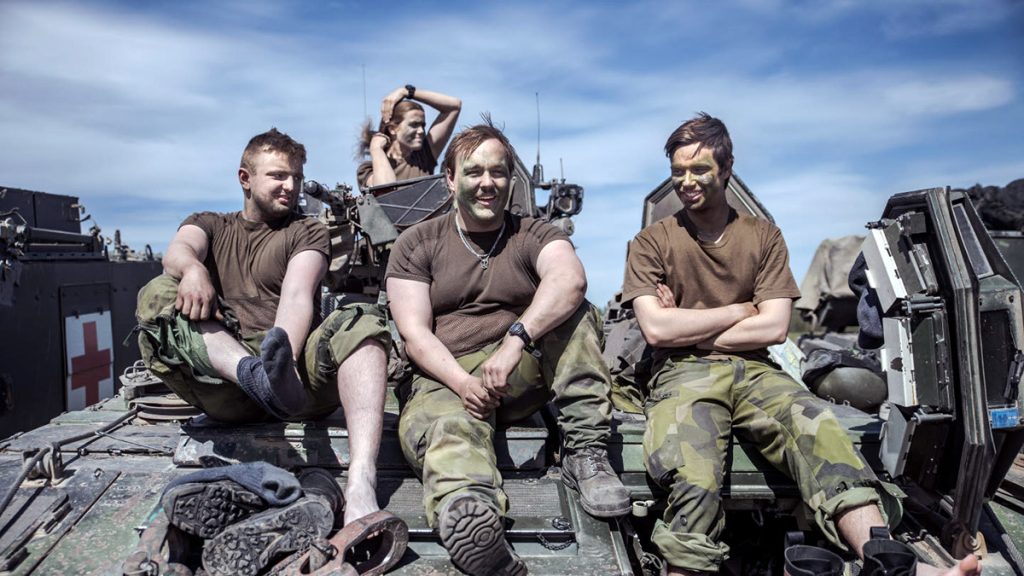
Swedish young soldiers. Press photo: Jonas Helmersson for the Swedish Armed Forces
Swedish NATO soldiers
Elsa Widding put the following questions to Pål Jonson during the interpellation debate:
Has Pål Jonson analysed the meaning of ”urgent situations”? What situations might prompt the government to send Swedish soldiers to Ukraine?
Can Sweden send elite troops to Ukraine without prior notice?
How many Swedish soldiers are at risk of dying in a Swedish military operation in Ukraine?
On 5 October 2025, Parliament approved a new decision-making regime for participation in NATO's collective deterrence and defence activities. This means that the government gets its own mandate in urgent situations to deploy armed forces for a limited time.
The amendment is about NATO collective defence and operations, not specifically about a peacekeeping force in Ukraine. This would still require a special parliamentary decision under the current rules. There is, of course, a risk of arbitrariness if the government can take such far-reaching measures for a certain period of time without either informing Parliament or allowing Parliament to make a decision.
My question is whether the Minister of Defence and the Swedish people understand what this means. If Sweden deploys troops against Russia, Sweden has declared war on Russia (without time limit).
What barriers are there now to the government sending Swedish soldiers to the war in Ukraine - to face certain death?
I would therefore like to put the following questions to the Minister for Defence, Pål Jonson:
Has the Minister analysed the meaning of ”urgent situations”, i.e. situations that may lead the government to send soldiers to Ukraine, and if so, can the Minister explain the results?
Could there be talk of Sweden sending elite troops to Ukraine without warning, and if so, can the Minister indicate whether or not Sweden has already sent elite troops to Ukraine?
Has the Minister analysed how many Swedish soldiers risk losing their lives in the event of a Swedish operation in Ukraine, and if so, can the Minister give an account of the results?
Hereby notifies the undersigned Member of Parliament, Elsa Widding, the Minister for Defence, Pål Jonsson, and the Prime Minister, Ulf Kristersson, for knowingly acting unlawfully, or aiding and abetting unlawful acts, in connection with the exercise of their respective ministerial roles.
The Minister of Defence and the Ministry of Defence, representatives of the armed forces, as well as responsible representatives of SAAB are now preparing further deals with Ukraine that risk damaging Sweden both economically and through a deteriorating reputation as a rule of law in the world.
A sale of up to 150 JAS Gripen is being prepared for Ukraine, which, as everyone knows, is in a very difficult economic and political situation. This means that the financing of this project is very uncertain. It has been discussed that the JAS plan will be paid for by EU countries by borrowing on the market which will further burden the economy of EU countries negatively.
Furthermore, these loans are to be secured by the utilisation of the illegally confiscated (”frozen”) foreign exchange reserves of the Central Bank of Russia recorded in Euroclear, Belgium's central securities depository.
All parties involved know that this is a violation of verified treaties, including Article 2 (sub-paragraph 4) of the UN Charter, which requires respect for the sovereignty and assets of all states, including central bank reserves.
Sweden's sale of JAS aircraft thus requires Sweden and the EU to violate the UN Charter. The Swedish government and parliament are thus deliberately violating internationally recognised statutes.
Parliament's duty is now to ensure that the government does not act in contravention of UN treaties, according to Parliament's primary mandate under the Swedish constitution.
On 14 November, Pål Jonson arranged a new deal for SAAB by signing an agreement with Colombia for the sale of 17 JAS Gripen aircraft. The problem is that the US considers the Colombian president to be a drug lord.
Gripen is a unique and flexible fighter aircraft that can take off and land on a straight road just 500 metres long. Now 17 of these aircraft will be sold to Colombia, writes Government Offices.
Benjamin Dousa hails the $4.3 billion deal:
The sale of JAS Gripen to Colombia is one of Sweden's largest export deals ever. It is a deal that strengthens both Swedish security and economy, and demonstrates the clear link between trade and security.
Pål Jonson, who acts as sales manager in the deal, says in a press release from the Government Offices that the sale is ”a clear acknowledgement of the competitiveness of the Swedish defence industry”. He adds: ”I look forward to deepening defence cooperation”.
In other words, Mr Jonson wants to sell more arms to Colombia.
The question is what the Pentagon thinks about it after the US implicitly threatened Colombia (like Venezuela) with military action to stop Colombian drug cartels.
Minister for Foreign Affairs Maria Malmer Stenergard who visited Colombia in January and participated in the first high-level dialogue under the bilateral partnership between Sweden and Colombia, also praised the sale:
Sweden and Colombia have very good relations that go back a long way. I look forward to continuing to strengthen and broaden the co-operation between our countries.
The Swedish ministers who sell fighter jets to SAAB, instead of SAAB's own salesmen, are entangling themselves in the arms industry and ending up in a geopolitical loyalty soup because Trump also considers Gustavo Petro to be a drug lord in Central America.
Last month, Donald Trump called Colombian President Gustavo Petro an ”illegal drug lord”. That gave Colombians cause for concern: the last country whose president Trump accused of running a drug business was Venezuela, and those accusations were used as justification to send a flotilla of warships to lie in wait off its coasts and blow up boats.
The war in Ukraine is coming to a head, with Russian forces facing less and less resistance and Ukraine struggling to find both soldiers and armour to send to the front. Foreign support has fallen by 41 % over the past year. Independent experts such as Professor John Mearsheimer, Alexander Mercourios, Colonel Douglas McGregor, Professor Glenn Diesen and many others agree that Ukraine's army is breaking down and the war is rapidly coming to an end.
JAS to Ukraine
In this critical situation, our Minister of Defence Pål Jonson and Prime Minister Ulf Kristersson, together with Volodymyr Zelenskyj, step forward to present a ”Letter of Intent” under which SAAB will sell 100-150 JAS 39E to Ukraine. The delivery is planned to start in three years, which raises questions. Do we not need to rejuvenate our own air force when many of the oldest JAS aircraft are now beginning to show their age? Nothing in these far-fetched plans seems to have any ground contact.
Russia's objectives in the war
Since the start of the invasion, Russia has declared the following objectives: to keep Ukraine out of NATO, to demilitarise the country and to ensure that Ukraine's military does not pose a threat to Russia in the future. At the moment, there is no indication that Russia will not have its demands met in the near future. The US, realising that the war is largely lost, has more or less withdrawn and seems to have no plans to supply Ukraine with more weapons. Despite this, Europe's leaders, including Pål Jonson, are apparently convinced that the war will continue for at least another decade, because that is the time SAAB needs to deliver these aircraft starting in early 2029.
SAAB and the government live in a fantasy world
By the time the planned JAS delivery begins, it is highly likely that the war will be over and Russia's demilitarisation demands already implemented. To think that Russia would accept Ukraine acquiring an air force of 100-150 JAS 39Es at that point is nothing more than childish wishful thinking.
Financing plans
How this whole dream project will be financed is even more baffling than the project itself. Pål Jonson stated in Aktuellt that Ukraine would be able to pay for the aircraft when the war is over. But how can a shattered country afford to buy fighter jets for around SEK 120 billion? There is also talk of possible export credits, which means that taxpayers will once again have to foot the bill for a massive state project. Even more serious are plans to use Russian frozen assets in European banks to finance this project, in effect pure theft. The European Commission plans to issue bonds with the Russian assets as collateral, which Sweden hopes to benefit from. So Russia will accept that their money is used to buy weapons to be used against them. Pål Jonson's plans are not only unrealistic, they are morally reprehensible. One day, the Russian money will be demanded back with interest under international law. Already now, the freezing of Russian assets is illegal because no European country is formally at war with Russia. The European Commission is acting as if the EU were a state, while seeming to forget that the EU is made up of many sovereign states with their different views on debt and decisions to declare war.
Marketing Yippee?
Pål Jonson and the government's spectacle, which took place in Linköping on 22 October, increasingly appears to be a publicity stunt commissioned by SAAB and its owners to promote the new JAS 39E Gripen. The new JAS aircraft is an absolutely world-class product and something we can be proud that our small country has managed to produce. But the marketing ploy launched by Pål Jonson and SAAB leaves a bitter aftertaste in that they are exploiting a desperate Mr Zelensky, who represents a country that is falling apart. For the government to engage in such activity is not only misguided; it goes against all norms of a civilised society. This is another example of the offensive cooperation between the state and capital, a so-called ”public-private partnership”, which definitely deserves to be scrutinised by the Constitutional Committee.
Major and former fighter pilot and spokesperson for defence issues, Ambition Sverige (A)
Sweden's defence has been dismantled since the Cold War. What remains largely follows the same thinking as then, both strategically, tactically and materially. While the modern battlefield has developed at breakneck speed, Sweden seems stuck in yesterday's solutions. So warns Göran Reuterdahl, a former intelligence officer and battalion commander in the navy and national defence forces.
Text by spokesperson Göran Reuterdahl, former intelligence officer and battalion commander in the Navy| This article was previously published in NewsVoice and Epoch Times (behind paywall)
The Ukrainian war has shown that classical military doctrine is dead. War today is no longer about large tank formations, company assaults or air dominance by air forces. Drones, UAVs, missiles/rockets and satellite surveillance have revolutionised the nature of combat.
Both Russia and Ukraine now utilise small, mobile units supported by drone technology. An artillery system, a tank or a gathering of soldiers is detected and engaged almost immediately, regardless of the weather or time of day. Traditional units are simply too vulnerable.
This does not just mean a technological shift, it requires a total re-think of how we think, organise and train our forces. Continuous innovation, tactical adaptability and rapid transfer of experience must become the norm.
Sweden's defence currently consists of two mechanised brigades. By comparison, at the end of the Cold War in 1991, Sweden had 26 brigades. Today's 10,000 soldiers are barely enough to defend half of Gotland.
The Swedish Armed Forces must be restructured from the ground up.
Our equipment is also outdated. The 122 (Leopard) tank, the Archer artillery and other Western systems sent to Ukraine have largely proved ineffective or outright unsuitable on the modern battlefield. The German armoured officer who compared the Leopard 2 in Der Spiegel to something better suited to a parade than to combat was painfully honest.
At the same time, Sweden has invested in the Patriot system, four batteries of around 100 missiles. These are not adapted to meet the kind of massive missile and drone attacks we are now seeing in Ukraine (and Israel), where Russia at times sends up to 700 projectiles per day.
For each incoming threat, 2-4 Patriot missiles are required, an unreasonable ratio both technically and economically. A missile equivalent to Shahed (about 50 kg payload) costs about USD 20 000, while a Patriot missile costs up to USD 4 million. Moreover, Patriot was originally developed to counter aeroplanes, and the system has great difficulty in dealing with missiles that are hypersonic.
The Swedish Armed Forces must be restructured from the ground up:
Focus on UAVs/drones, missiles (including hypersonic), electronic warfare and information superiority.
New tactics with small, mobile and decentralised units.
A highly developed intelligence service with the right skills.
A defence industry that values innovation over administration.
An officer corps that promotes entrepreneurship and innovation, not just tradition.
We live in a new era, but with a defence force and security policy thinking from another time. It is high time we asked the hard questions, questioned our assumptions and renewed Sweden's security policy from the ground up, with a mandate from the people.
Text: Göran Reuterdahl, former intelligence officer and battalion commander in the Navy, spokesperson for the Ambition Sverige party
President Donald Trump's speech at the UN was astonishing in many ways. With a clarity of language rarely heard from a politician, he reinforced a conflict that affects Europe and Sweden deeply. It is time to ask what the US has done to Sweden.
Since the explosion of Nord Stream 1 and 2, Europe's economy has been plagued by recession. There are many indications that the US was involved. Joe Biden was clear when he said:
”If Russia goes into Ukraine, there will be no Nord Stream 2.”
Six months after Russia entered Ukraine, the gas pipelines were blown up in September 2022. The detonations were so powerful that they were recorded by seismological stations around the Baltic Sea as a minor earthquake.
The official explanation, that five men and a woman from Ukraine, on a rented sailboat, carried out the blast, seems absurd. Yet we in Europe have bought this explanation without further ado.
One wonders whether our leaders are acting in ignorance or whether they are steadfastly loyal to a United States that now sells natural gas to Europe at a price several times higher than Russian gas. The result is a weakening of Europe's industrial competitiveness due to sky-high energy prices.
The trade war against Europe
The US has also launched a trade war against Europe with high tariffs on European goods, further destroying one of our most important export markets. President Trump is encouraging companies to move factories to the US and with it, ”USA is open for business,” he reinforces the divisions between us.
With a nationalist agenda, President Trump's willingness to protect his own country is honourable, but it is strange that European leaders accept this without resistance. How can the US act in a way that harms its main ally in this way?
US conflicts of interest
Since the early 2000s, the United States has taken a keen interest in Ukraine, with involvement in the Maidan revolution and subsequent regime change. During the civil war, which started in 2014, the US has helped build Ukraine's military into one of the most powerful in Europe.
The strategy against Russia has been to use sanctions and a protracted war to destabilise and divide the country in order to access its natural resources.
But now, as President Trump seems to realise the failure of this strategy, he is changing tactics and shifting the costs of the conflict to the EU.
In an agreement between the EU and the US, signed by Ursula von der Leyen, EU countries commit to buy €750 billion worth of US weapons and also LNG (Liquefied Natural GasThis is yet another reminder of how disastrous the US behaviour is for Europe and will put future generations in debt.
A dangerous future
President Trump makes the astonishing observation that European leaders, who seem convinced of Ukraine's victory, no longer need US support. First the US creates the conflict and then passes the buck to Europe. Europe's leaders have themselves helped build the myth that Ukraine can emerge victorious from its conflict with Russia by constantly distorting the truth and talking about Ukraine's coming victory.
It is Europe and Sweden that will pay a heavy price for this capitulation to President Trump and the US agenda. A continuation of the conflict benefits no one and only risks exacerbating the situation with further loss of life on the Ukrainian battlefield. The EU and NATO have once again proven to be a disaster for Europe and Sweden.
An alliance in crisis
Now President Trump is also demanding that we do not buy cheap Russian oil from third countries. He has not succeeded in destroying Russia, but he is well on his way to destroying Europe. By imposing a war we didn't cause, making it harder for us to buy cheap energy and imposing high tariffs on our exports, he is undermining our economic stability.
Meanwhile, President Trump is trying to normalise US relations with Russia, while the EU and Sweden continue to isolate themselves and wage an unforgiving and provocative war of words against Russia. This is creating a deep rift between our countries that will be very difficult to bridge. With the current regimes in Europe, it seems almost impossible.
Russia is one of our closest neighbours and will not go away no matter how much our leaders would like to see this happen.
It is now high time for our politicians to realise that Sweden's interests do not coincide with those of the United States. Their interests do not benefit our country and therefore we must never let ourselves be ruled by external powers.