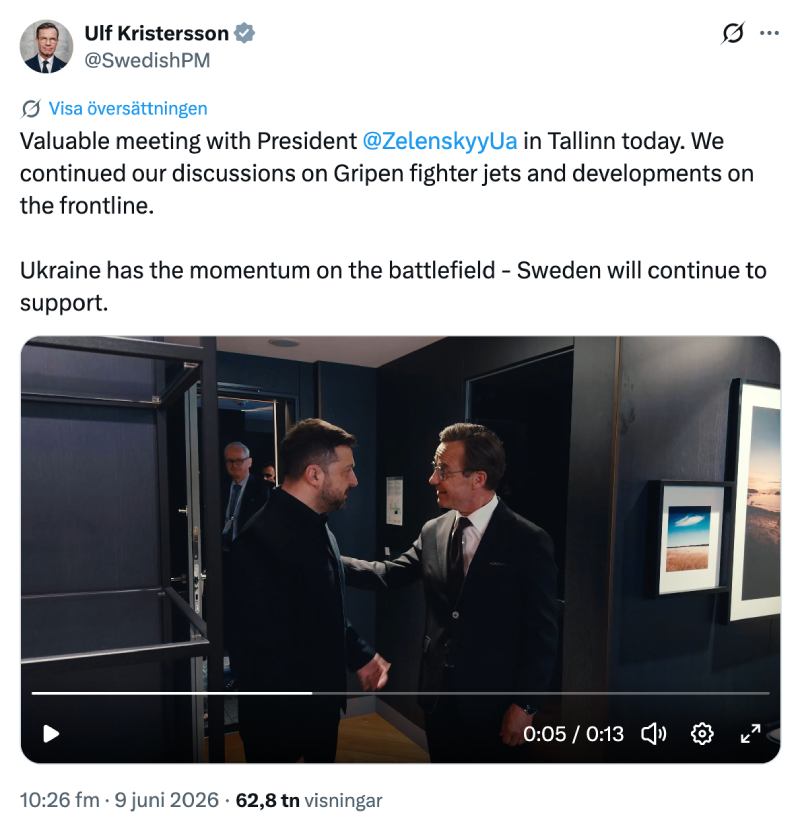
The JAS 39 Gripen aircraft, which Sweden is considering sending to Ukraine, is not the biggest problem, according to security expert and former fighter pilot Ulf Gabrielsson. The Gripen's missiles can reach Moscow and deep into Russia. That is where the danger for Sweden lies.
It is instead the advanced weapons that are planned to be integrated onto the aircraft, particularly the German The long-distance robot Taurus, which he sees as a serious threat to Swedish security.
In a statement, Gabrielsson warns that the Swedish weapons systems dramatically change the risks for Sweden. This concerns up to 36 Gripen aircraft that the government wants to donate and sell to Ukraine.
”They're not messing about. It's a long-range air-to-air missile that can shoot down other aircraft from up to ten miles away, that's one hundred kilometres,” he says.
The Gripen's robots can reach Moscow and deep into Russia
The Meteor missile [not the Taurus missile as the editor incorrectly wrote] can pose a significant threat to Russian aircraft, which currently operate relatively freely as they launch missiles and drop glide bombs on Ukrainian targets. The Meteor missile has a range of over 200 kilometres.
”A JAS can take down this robot over Ukrainian airspace and it can reach as far as Moscow. It weighs 1,500 kilos, has a 500-kilo TNT warhead, and can take out bunkers, bridges, and ships,” warns Gabrielsson.
He stresses that the weapons would be very effective for Ukraine, but from a Swedish perspective, he sees significant risks:
”Looking at Sweden's security, this is a huge threat to us. We are becoming an even higher priority target, and our arms industry, with SAAB in Linköping and SAAB Dynamics in Trollhättan manufacturing parts for the Taurus missile.”
The statement comes at a time when the government and the Armed Forces are investigating a comprehensive delivery of Gripens to Ukraine, concurrently with Sweden already supporting Ukraine with other weapon systems and ammunition.
A decision on the aircraft and their weapon load is expected in the near future.
Ulf Gabrielsson has previously criticised Swedish security policy and warned that increasingly deep Swedish involvement in Ukraine could draw Sweden into a direct confrontation with Russia.
In a announcement varnar Gabrielsson för att svenska vapenfabriker i t.ex. Karlskoga kan attackeras av ryska missiler om svenska plan används för att slå till djupt in i Ryssland. Putin har nyligen gett det ryska försvaret grön signal för att attackera utländska vapenfabriker som tillverkar vapen som används mot Ryssland.
The warmongers want war. If you win the war, you write history. If Putin wins, our politicians will end up on history's rubbish heap along with everything else our “democ-tatorship” has planned to control the people. Historically, rulers have threatened "if war comes" to retain power – then the war comes.
Had Mr Hitler won, encouraged by many leading figures in this country, we would be speaking German today, not English. .
Geopolitics
My memory consists of 1kg of fat. The best before date has passed. Sometimes it's difficult to remember what I'm supposed to do after I've unlocked the door. But I remember the book “1984”; I read it about 60 years ago. I remember the manipulation of power with Newspeak. “War is peace.” That's where we are now with the Eternal war and the Ministry of Truth. The struggle is ongoing between the superpowers Oceania, Eurasia, and Eastasia (USA, Russia, China) with their constant wars.
It is from this eternal balance of power that the Party's famous slogan arises: ”War is peace”. Since the state of war is completely stable and permanent, the effect is the same as permanent peace – nothing changes in the power structure.
They are too equal: None of the three superpowers can be completely defeated, not even if the other two join forces in an alliance. They are simply too large and have too strong natural defences.
Alliances are constantly shifting. Just so that no one becomes the absolutely dominant “strong” power, the alliances shift all the time. If one country risks becoming too powerful, the other two immediately join forces to restore the balance.
War is an illusion Since no one can win, the war is in practice permanent. The real purpose of the war is not to defeat the enemy, but to consume society's economic surplus. By keeping the population poor and afraid, the elite can maintain their absolute power over the citizens.
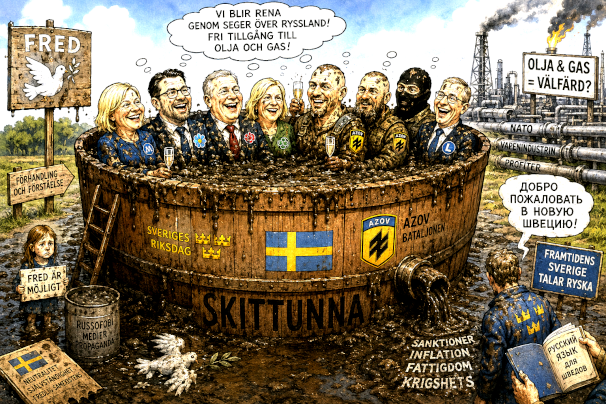
Our political elite, “The Party,” has jumped into the wrong barrel. The Atlantic Council, Nato's lobby with Wallenberg, Bildt, Pål Jonsson, and other supporters of Pax Americana, has sold out Sweden's sovereignty to get a piece of the spoils after the divided Russian empire. Western economies need constant growth to cope with their increasing debts; ”He who is in debt is not free.”.
The Swedish policy pursued is that “Putin must not win”, it is not said that “Nato must win” because there is no plan or strategy for how that would be possible. The war must therefore continue with millions dead. If Putin wins, the politicians, “The Party”, will have to show all their dirt. From 2014 to 2020, the outskirts of the million-strong city of Donetsk have been shelled and bombed. 14,000 deaths, including 600 children, have been reported. Two broken peace agreements were made, according to Merkel and Hollande, so that Nato could rearm Ukraine. The violations have been registered and documented by OSCE with Nato personnel. Note 14,000 killed and a new large attack on 19/02/2022 against Donetsk (not Kyiv) documented in detail by OSCE. See the extensive OSCE report. It was a provocation and a outright attackfrom Kyiv.
Consequence: The political elite, the “Party,” cannot step out of the barrel because the neo-Nazi filth would then be visible. They continue to send increasingly deadly weapons, causing more deaths of Russian soldiers and civilians. Russia is registering this but has tactically refrained from counter-attacks thus far. With the USA occupied and NATO's armouries depleted, the situation will change.
Järfälla’s military-strategic industries are potential bombing targets.
All public authority in Sweden derives from the people, and the Riksdag is the people’s foremost traitor.
The Swedish people are going to the polls. The election is about War or Peace..
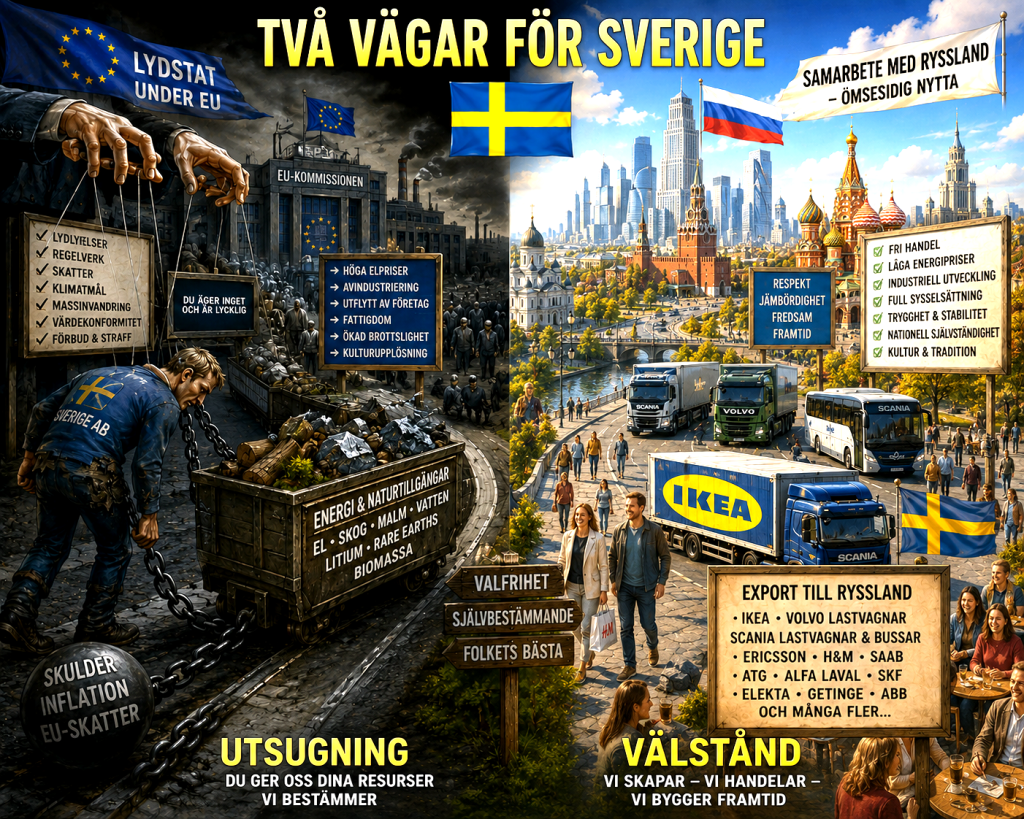
a brief historical description of trade with Russia:
During the 19th century, under a new French king (who was not Russophobic), we enjoyed extremely good trade relations with Russia. Nobel, L M Ericsson, Atlas and others were major industrial firms with pioneering technology in Russia.
1918: Lenin, economically sponsored by Swedish and German interests, seized power. Many fortunes were made, both legally and illegally, while others suffered significant losses. Lars Magnus Ericsson lost his factory in St. Petersburg and control of the entire company in Sweden. Other companies sold locomotives, electric generators, and turbines for hydroelectric power plants, among other things.
1939: The Winter War was a war over nickel. The Soviet Union lacked nickel for its war industry in the run-up to the impending war with Nazi Germany. The mine in the town of Nickel had ended up on the wrong side of the border, according to the Russians. During the war years, nickel production was exported to Germany, which was short of raw materials. After the war, the town ended up on the Russian side.
Sweden's exports to the Soviet Union during the period 1945–1991 were high-tech and industrial. As a neutral country with a strong engineering industry, Sweden managed to balance between Western restrictions (CoCom) and Moscow's great need to modernise its economy.
Swedish exports to the Soviet Union consisted primarily of the following goods:
Engineering and Mechanical Engineering: This was by far the largest export category. Sweden sold heavy machinery, turbines, generators and complete factory equipment, including machinery for the Soviet paper and pulp industry.
High-quality steel and metal products: The Soviet Union needed Swedish special steel, stainless steel pipes and, above all ball bearing from SKF, which was a critical component for their heavy industry.
Telecommunications: Telephone Limited Company LM Ericsson played a key role. Sweden exported advanced telephone exchanges and telecommunications systems to help expand the Soviet telecommunications network. Standard Radio computers for the Bajhonour space station. Datasaab Air traffic control computers. .
Transport equipment and ships: Swedish shipyards built and exported specialised vessels, refrigerated ships and fishing boats to the Soviet merchant fleet. They also supplied heavy goods vehicles and spare parts from Volvo and Scania was exported.
Food industry equipment: Companies that Alfa Laval exported separators, dairy plants and other equipment to improve the efficiency of the Soviet food supply chain.
SAS was the first airline with scheduled services. Volvo was the only foreign car brand with a service workshop in Moscow.
Since 1991, a number of Swedish companies, both large and small, have established themselves in Russia in addition to those mentioned above, such as IKEA and H&M, with sales and production operations. For example, Volvo Trucks accounted for 9% of Russian production of heavy goods vehicles.
Following the sanctions imposed by the West on companies operating in Russia, Chinese firms have taken over the market.
The political class does not work for the country, they work for poverty and eternal war.
We have to change, no one else cares!
It is your DUTY!
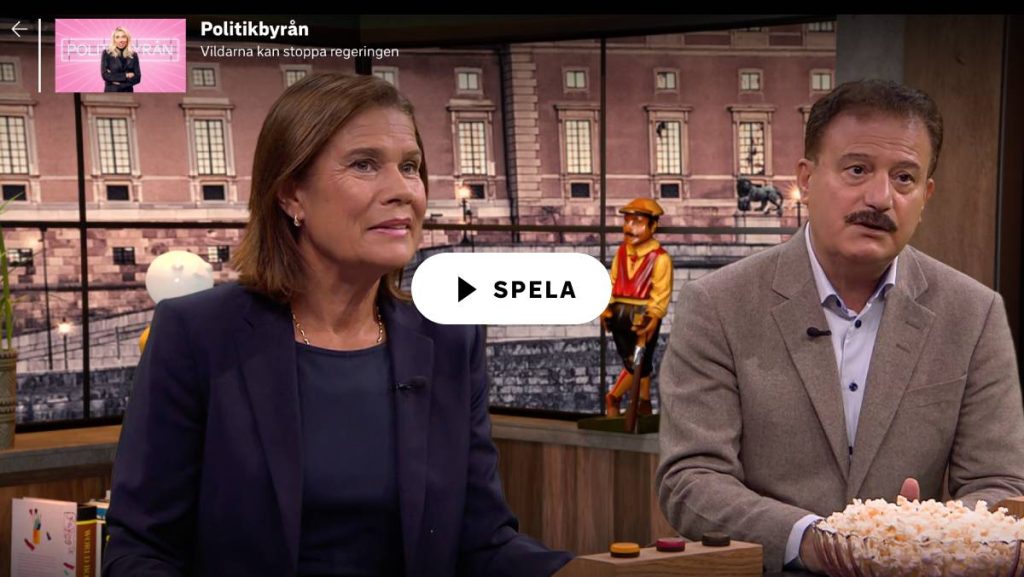
Elsa Widding, Jamal El-Haj and Lorena Delgado Varas all decided to remain in Parliament – despite breaking with their respective parties. Now the ”parliamentary troublemakers” meet in the Politics Bureau studio for a discussion about what it's like to go against your own party colleagues.
Furthermore, they will reveal how they intend to vote on some of the spring's hottest issues where government policy is at risk of falling. Guests: the party-affiliated MPs Elsa Widding, Jamal El-Haj, and Lorena Delgado Varas.
Programme leader: Karolina Skoglund.
SVT
Thabo Motsieloa interviewed MP and political maverick Elsa Widding on the podcast Zeitgeist Sweden.
Amidst the storm that has followed the conflicts with the Tidö parties, criticism from Jimmie Åkesson, and the threats that have led her to cancel public appearances before the election.
In a long conversation with Thabo Motsieloa, she talks about the war in Ukraine, NATO, the EU, Swedish sovereignty, and why she believes Sweden is being drawn deeper and deeper into a great power conflict.
Widding directs sharp criticism at the media, the DCA agreement, migration policy, and what she describes as an increasingly narrow public discourse.
She also talks about the threats, democracy in Sweden, the energy crisis, and why many people, in her opinion, no longer feel represented by the established parties.
Source: Thabo Motsieloa, Zeitgeist Sweden
The latest witch hunt against me has crossed all boundaries. It wasn't about substantive issues, arguments, or political choices. It has been a wave of personal hatred, suspicion, and direct threats of violence. The feeds contain not only harsh words, but also direct and detailed threats. One of them described how I would be cut into small pieces.
This is not a price anyone should have to pay to participate in politics.
What triggered this hatred?
The trigger was the latest vote on stricter requirements for Swedish citizenship.
In that question, it was claimed that I voted against stricter requirements. That is not true. I voted for seven out of eight decision points and stand behind stricter requirements for Swedish citizenship.
Yet Jimmie Åkesson claimed in Sunday's party leader debate on SVT that I had received bribes from the Green Party. How can a party leader stand on public service broadcasting and spread a false claim about bribes?
In the current political climate, where lies quickly become fuel for witch hunts, hatred and threats, this is deeply irresponsible. When a person in Jimmie Åkesson's position says something like that publicly, he reinforces the suspicion and amplifies a climate that has already gone far beyond the limit.
What responsibility do political leaders actually take for the consequences of their words and statements?
The decision point where I made a different assessment concerned transitional rules for individuals who had already applied for citizenship under previous regulations, where the requirement had been five years' residence in Sweden instead of eight.
My conclusion was that there was very little to be gained from lacking clear transition rules, but an obvious risk of more legal proceedings, overloaded authorities, and unnecessary costs for taxpayers.
When laws change mid-process without clarity on how the transition should be handled, the risk of different interpretations, longer proceedings, and more complicated application increases. I also see a risk that this will largely become a symbolic gesture, while the practical consequences could be increased uncertainty.
I have weighed arguments, analysed and come to my own assessment. Therefore, I chose to vote differently on one out of eight decision points.
Let me also make it clear: I took this decision as a Member of Parliament, not as leader of the Ambition Sverige party.
At the same time, I want to be clear: I support stricter requirements for Swedish citizenship, which I also voted for in the ballot.
I want to see a migration policy based on order, responsibility and clear rules. Sweden must regain control over migration and ensure that immigration occurs in a way that is sustainable for the country.
My starting point is simple: anyone who immigrates to Sweden should support themselves through honest work, respect Swedish law, and contribute to society.
I have drawn up Ambition Sverige’s migration policy programme, which focuses specifically on these issues. Please feel free to read the party programme on Ambition Sverige’s website: ambitionsverige.se
More or less democracy in the Swedish Riksdag?
The Swedish parliamentary system is based on individual MPs being present in the chamber and voting by pressing a green, red, or yellow button. This may sound technical, but behind every button press lies personal responsibility.
Sweden is a representative democracy. Voters vote for parties, but they also elect members who are expected to familiarise themselves with issues, understand the consequences of decisions, and ultimately take responsibility for their vote. A Member of Parliament is not elected to be a mechanical extension of the party leadership.
In the debate about setting off, it has become clear that the Sweden Democrats' leadership considers it a given that not only SD's own members will vote according to the party line, but also independent members – so-called political independents – who previously belonged to the party.
The group leadership within the Sweden Democrats consists of group leader Linda Lindberg, deputy group leader Henrik Vinge, and second deputy group leader Julia Kronlid. At the parliamentary group's meetings, members are informed about the policy in upcoming votes. This in itself is nothing unusual. All parties work with coordination.
The problem arises when the party line is no longer a recommendation, but in practice a Compulsion. When members who might vote the wrong way are excluded rather than allowed to attend and vote according to their own convictions, then we have a democratic problem.
Before the vote on Nato, I and several other members were swapped out. I had voted no. But through the swap, my vote never had to appear on the roll call.
This is precisely the point.
The offsetting system is intended to manage absences so that the balance of power in parliament is not affected by illness, travel, or other practical hindrances. It is not intended to be used as a way to control or neutralise members who may vote according to conscience, knowledge, or their own analysis.
When set-off is used in that way, the issue becomes bigger than a single vote. Then it's about whether parliament consists of 349 independent members or if the chamber is practically just an extension of the party group leaders.
The system for voting simultaneously relies on personal accountability that extends beyond committee work and party meetings. Individual members ought to know what they are voting for or against, particularly on major and fundamental issues.
If members are not expected to think for themselves, if they are not allowed to follow their conscience or their own knowledge on crucial matters, then the voting buttons might as well be removed. In that case, members could stay home, and the voting could take place directly based on the parties' allocation of seats and the group leaders' instructions.
In such an arrangement, the Members of Parliament have in practice played out their role.
A significantly more serious problem than the existence of a few uncontrollable and unbribable non-party-affiliated members of parliament is that other members often lack the practical ability to vote according to their inner conviction or moral compass on sensitive issues.
A clear example is the vote on legal gender reassignment at the age of 16. The Moderate Party member who went against the party line and voted no demonstrated precisely the courage a free mandate is intended to enable. But everyone who dares to go against the party line also knows that the price can be high.
This should be discussed more.
Because if every independent voice is treated as a problem, and every deviation from the party line is punished, what then remains of representative democracy?
The free mandate does not exist to cause disorder. It exists to ensure that Parliament is not reduced to a predictable button-pushing machine.
A Member of Parliament who is never allowed to think for themselves is not actually needed.
Then we won't get more democracy. We'll get less.
When independence is called bribery
Jimmie Åkesson claims that Katja Nyberg and I have accepted bribes from the Green Party. Both Katja and I voted for seven out of eight points in the proposal for stricter requirements for Swedish citizenship. We therefore voted for a tighter migration policy. Trying to describe this as if we were acting on behalf of the Green Party is not serious.
The point at which I made a different assessment was regarding transitional rules. I believed that the absence of clear transitional rules risked creating more legal proceedings, higher costs, and more strain on already overburdened agencies.
You can criticise that. You can think I was wrong. But calling it bribes is something else entirely.
When a party leader makes such an accusation against independent members, they contribute to poisoning political discourse. Moreover, they do something else: they attack the very idea that a Member of Parliament can make an independent decision.
A free mandate means something. If every independent vote and deviation from the party line is to be explained by bribery, then the problem is the perception of democracy.
My message is and has always been: Think for yourself!
For me, it’s not a slogan, but a lifelong approach. In my professional life, in public debate, and in Parliament, I've always tried to remain free enough to analyse, evaluate, and draw my own conclusions. I did that in the latest vote as well.
My hope is that more people will dare to do the same, in parliament, in public debate and in Sweden at large.
For a free society, free people are required.
People who dare to think for themselves, even when the winds are blowing.
Who should Sweden be for – and where did the "Folkhemmet" go?
There are moments when we must stop and ask: What are we doing? Who are we building society for? And who is paying the price?
In Bäckebo lives Ingemo Keib, aged 78. She is a widow and in poor health, a person who has done everything ”right” in life. She has worked, paid taxes, looked after her family, and tended to her home. A person who has never asked for more than to live her final years in security.
But in today's Sweden, that's no longer enough.
She is now forced to pay for a VA connection she never ordered, an ”opportunity” she cannot use. She is forced to mortgage her home to finance a decision she was never involved in. She is forced to live on 800 kronor a month while the municipality takes 72,422 kronor in seizure.
She is forced to confront an authority with unlimited resources, while she herself can't even afford to take a new water sample.
This is not befitting a country that once built its society on the idea of security, solidarity, and justice.
This is not worthy of a country that called itself a people's home.
What is a 'folkhem' if not a promise? A promise that the weak will not be crushed by the system. A promise that the elderly will not have to fear their own municipality. A promise that authorities will stand by the citizen – not above them.
Today we are seeing something else. We see how regulations, written far from people's everyday lives, are applied without regard for the consequences. We see how municipalities refer to ”strict legislation” while people lose their homes. We see how financially weak households are forced to bear costs that would break even a well-off family. We see how the balance of power has shifted – from the citizen to the authority.
People like Ingemo, who have helped to build this country, are now being forced to give up the little they have left.
It is not only unfair, but inhuman.
When people can no longer defend themselves against such decisions, when they are forced to remortgage their homes to comply with incomprehensible municipal regulations – then something important in society has broken.
That is why the association ”VA i Tiden” (Water Supply in Time) exists. That is why we write and protest.
Ingemo's fall is not an exception, but one of many cases that show we have a systemic error.
We are not demanding privileges or special treatment. We are simply demanding what was once self-evident: that people be treated with dignity and that authorities take responsibility for their own mistakes. That laws be applied with reasonableness. Is this truly too much to ask?
Mikael Richter Ambition Sverige
Stop starving our elderly on the altar of climate alarmism
Sweden has a growing debt to the generation that built the country. This isn't just about pensions or hospital beds, but about something as basic as the food on the plate. Under the guise of ”climate-smart food” and the finger-wagging of Agenda 2030, our elderly are today being forced to eat a nutrient-poor diet that directly harms their health. It's time we stopped prioritising ideological climate narratives over science and quality of life.
Science speaks plainly
The research is clear, but is widely ignored by the politically correct in the corridors of power. Studies published in, among others The Journal of the Medical Association showing that a higher intake of meat is linked to a lower risk of dementia. Older people who eat plenty of meat and animal protein exhibit significantly better cognitive ability than those forced onto a plant-based diet. Meat is not just food; it is brain fuel.
Older people need more protein, more fat, and higher nutrient density to maintain muscle mass and cognition. At this stage, replacing nutritious meat with processed substitutes or ”climate-smart” vegetable purées is nothing short of a medical experiment on a defenceless group.
Malnutrition as a result of climate hysteria
While we talk about sustainability, food waste in elderly care is increasing at an alarming rate. Why? Because the food served is in far too large portions to provide adequate nutrition. When the food doesn't taste good or satisfy, it ends up in the bin. The result is spiralling malnutrition, leading to falls, confusion and premature death.
It is an absurd betrayal that Swedish tax money is used to finance a ”climate transition” that is literally starving our taxpayers. To pit human health against a dubious climate narrative is deeply unethical. Agenda 2030 has become a straitjacket that suffocates common sense and evidence-based healthcare.
Ambition Sverige calls for change
We at Ambition Sverige do not accept that our elderly are being made the victims of international agendas and scaremongering. We demand:
Real meat on the plate: Proteins and fats from animal sources must be prioritised to ensure cognitive health.
Evidence over ideology: Costs within elderly care should be guided by geriatric research, not by climate activists.
End of the platitudes: Throw Agenda 2030 in the bin and focus on ensuring that those who built our country receive the nourishment they deserve.
Providing our elderly with proper food is not a climate issue – it is a matter of basic respect and medical decency. It is time we prioritised Swedish lives over global narratives.
Anneli Kullberg
Ambition Sverige Mark
Imagine your grandmother, mother, grandfather. She who baked cinnamon buns, he who told stories from the war and held your hand when you were scared. Now they sit and wait for home care. The plastic container with the industrially produced food needs to be heated in a non-existent microwave. The vegetables are pale, the pea patty tasteless and the potatoes overcooked. The nutritional content makes the elderly weaker each day. Undernourished, exhausted, alone. The staff don't have time to sit and talk. They hurry on to the next.
When she coughs a bit too much or seems tired, the ”comfort injections” suddenly appear. Palliative care, they call it. ”Grandma is going to die,” as the investigative journalism programme so ruthlessly revealed in its series. Medications intended for the very last hours of life are given to people who are still eating, drinking, and awake, sometimes without a proper medical examination and without relatives always being informed. This is not end-of-life care – it is active euthanasia in practice, hidden behind fine words and overloaded systems. How many grandmothers and grandfathers have faded away too early because someone somewhere thought it was "reasonable"?
Meanwhile, those who are still struggling are forced to deal with a society that no longer sees them. BankID, e-services and soon government digital IDs where everything is to be done via mobile phone or computer. Those who have never learned, who have trembling hands and impaired vision, or simply cannot afford the latest technology, are excluded. They cannot book appointments, pay bills or even ask for help. They become invisible. Forgotten in a Sweden that prioritises efficiency over human dignity.
This is not a coincidence. It is the result of a system that for decades has prioritised other things than those who built Sweden. We have seen how money has gone to things other than core operations, how bureaucracy and digitalization have hit the weakest hardest. And we, their children and grandchildren, have let it happen. We have hurried past, believing that our social safety nets work. Our parents have also believed that help would be there when it's needed most. But it isn't there anymore.
It's time to feel the shame. For real. For every cold meal, every unnecessary injection, every elderly person who can't reach their home care because the system demands an app.
We at Ambition Sverige In our party manifesto, we have a clear stance: elderly care should be based on Safety, dignity and respect for the individual human. The party RequiresLegal protection in elderly care and that we prioritise Swedish pensioners who have toiled their entire lives. We want to significantly raise the basic deduction for pensioners so that those who built the country can keep more of their pension and avoid living in poverty. Migration, war and EU membership are draining resources from welfare – money that should instead go towards better food, more staff and care that doesn't treat people as costs.
We need a policy that puts people first again. That says no to digitalisation that excludes the generation that fought for our prosperity. That demands that palliative care is indeed relief – not a shortcut to death. That ensures food is warm, nutritious, and served with time and dignity.
Your grandmother, father or uncle doesn't deserve to die in silence while we scroll on. They deserve to be seen, heard and valued until the very end. It's time to wake up. It's time to demand elderly care with ambition – not acceptance of decline.
Anneli Kullberg
Ambition Sverige Mark
Statement regarding KST 2018/503 Detailed Development Plan for Barkarby Centre, the property Barsbro 7:2 and others
I have read the proposal for the detailed plan and am appalled at how low the municipality's responsible parties can stoop to continue the total destruction of a previously relatively good municipality, at least when we moved here.
There is absolutely no need for further construction in the municipality, and especially not in Barkarby-Skälby, before Barkarbystaden and other developments are completed, among other things. If it then turns out that there is some demand, one can always consider how to proceed. Even today, there is a surplus of apartments in various forms and costs are of a sky-high nature.
The municipality already has loans exceeding 5 billion, approaching 6. Grants are in the order of 1 billion per year with a budget of just over 4. There is much to say about how the municipality's finances are managed, but it is abundantly clear that further construction projects will only add to the burden without any real need.
Everything has the characteristic of politicians seeming to thrive on large projects that are likely to appeal to their egos by having what are perceived as important assignments. Unfortunately, this affects the residents, who generally do not request these types of cost increases and densification.
What also needs to be mentioned is that the whole of Barkarby-Skälby has completely changed in character from being a pleasant garden villa area to something that is more accurately described as a shanty town or a sprawl of villas. Despite naive attempts over the last 10 years through master plans and guidelines to curb the development, the building permit department seems to have had a mantra of build, build, build… One of many nails in the coffin was also when Barkarby Bridge was closed to car traffic, totally unacceptable! Start by reopening it so that traffic can begin to flow again in a sensible manner. I can only conclude that during the 40 years I have lived in the district, it has, through the collective efforts of politicians and civil servants, been destroyed in a way that should be prosecutable.
So, the statement summed up is: Bury the entire development plan! (and reopen Barkarby bridge)
Further steps would be to instead try to work for the good of the municipality with things that also benefit existing residents.