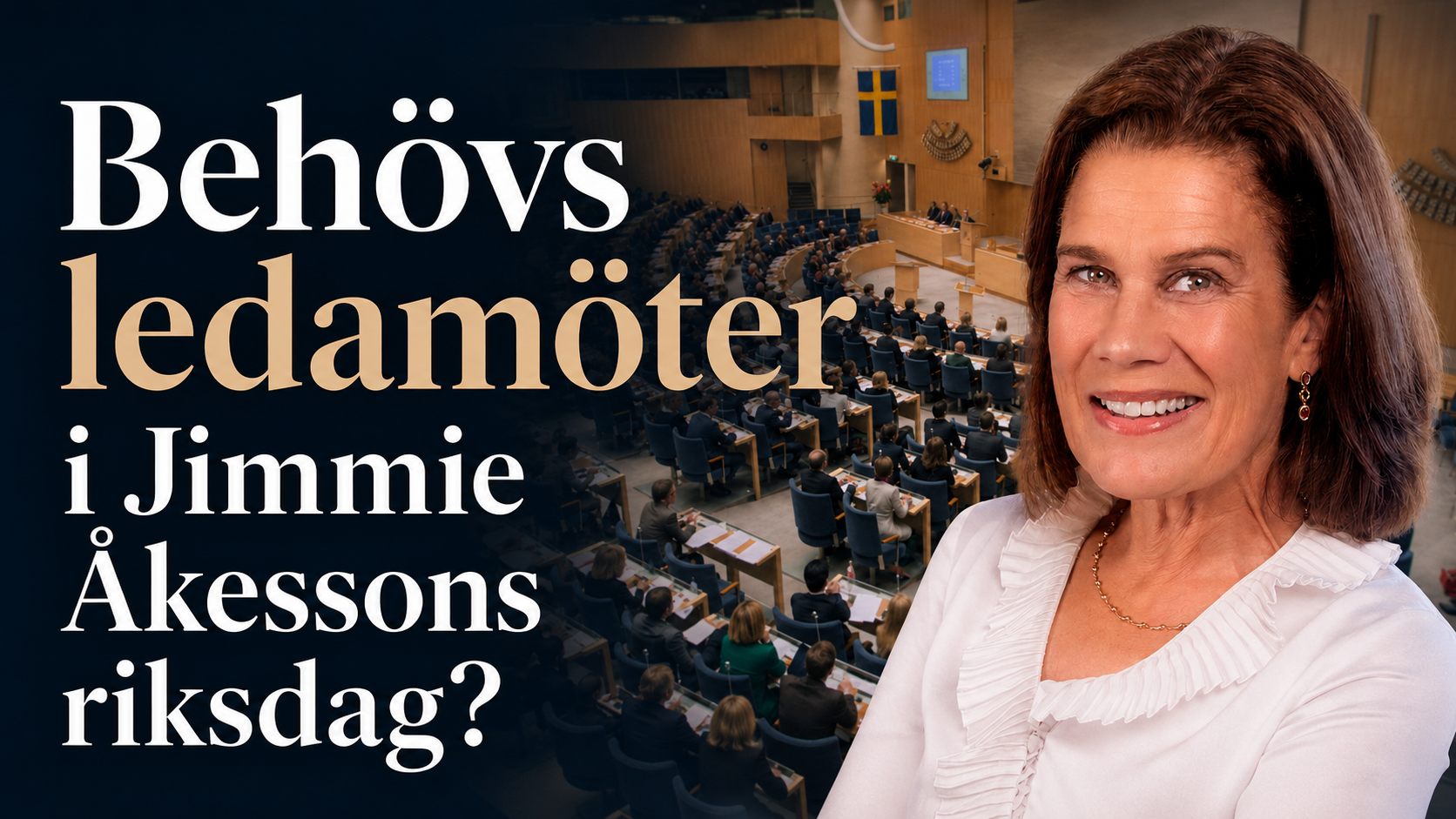
Is there a need for members of Jimmie Åkesson’s Riksdag?
The latest witch hunt against me has crossed all boundaries. It wasn't about substantive issues, arguments, or political choices. It has been a wave of personal hatred, suspicion, and direct threats of violence. The feeds contain not only harsh words, but also direct and detailed threats. One of them described how I would be cut into small pieces.
This is not a price anyone should have to pay to participate in politics.
What triggered this hatred?
The trigger was the latest vote on stricter requirements for Swedish citizenship.
In that question, it was claimed that I voted against stricter requirements. That is not true. I voted for seven out of eight decision points and stand behind stricter requirements for Swedish citizenship.
Yet Jimmie Åkesson claimed in Sunday's party leader debate on SVT that I had received bribes from the Green Party. How can a party leader stand on public service broadcasting and spread a false claim about bribes?
In the current political climate, where lies quickly become fuel for witch hunts, hatred and threats, this is deeply irresponsible. When a person in Jimmie Åkesson's position says something like that publicly, he reinforces the suspicion and amplifies a climate that has already gone far beyond the limit.
What responsibility do political leaders actually take for the consequences of their words and statements?
The decision point where I made a different assessment concerned transitional rules for individuals who had already applied for citizenship under previous regulations, where the requirement had been five years' residence in Sweden instead of eight.
My conclusion was that there was very little to be gained from lacking clear transition rules, but an obvious risk of more legal proceedings, overloaded authorities, and unnecessary costs for taxpayers.
When laws change mid-process without clarity on how the transition should be handled, the risk of different interpretations, longer proceedings, and more complicated application increases. I also see a risk that this will largely become a symbolic gesture, while the practical consequences could be increased uncertainty.
I have weighed arguments, analysed and come to my own assessment. Therefore, I chose to vote differently on one out of eight decision points.
Let me also make it clear: I took this decision as a Member of Parliament, not as leader of the Ambition Sverige party.
At the same time, I want to be clear: I support stricter requirements for Swedish citizenship, which I also voted for in the ballot.
I want to see a migration policy based on order, responsibility and clear rules. Sweden must regain control over migration and ensure that immigration occurs in a way that is sustainable for the country.
My starting point is simple: anyone who immigrates to Sweden should support themselves through honest work, respect Swedish law, and contribute to society.
I have drawn up Ambition Sverige’s migration policy programme, which focuses specifically on these issues. Please feel free to read the party programme on Ambition Sverige’s website: ambitionsverige.se
More or less democracy in the Swedish Riksdag?
The Swedish parliamentary system is based on individual MPs being present in the chamber and voting by pressing a green, red, or yellow button. This may sound technical, but behind every button press lies personal responsibility.
Sweden is a representative democracy. Voters vote for parties, but they also elect members who are expected to familiarise themselves with issues, understand the consequences of decisions, and ultimately take responsibility for their vote. A Member of Parliament is not elected to be a mechanical extension of the party leadership.
In the debate about setting off, it has become clear that the Sweden Democrats' leadership considers it a given that not only SD's own members will vote according to the party line, but also independent members – so-called political independents – who previously belonged to the party.
The group leadership within the Sweden Democrats consists of group leader Linda Lindberg, deputy group leader Henrik Vinge, and second deputy group leader Julia Kronlid. At the parliamentary group's meetings, members are informed about the policy in upcoming votes. This in itself is nothing unusual. All parties work with coordination.
The problem arises when the party line is no longer a recommendation, but in practice a Compulsion. When members who might vote the wrong way are excluded rather than allowed to attend and vote according to their own convictions, then we have a democratic problem.
Before the vote on Nato, I and several other members were swapped out. I had voted no. But through the swap, my vote never had to appear on the roll call.
This is precisely the point.
The offsetting system is intended to manage absences so that the balance of power in parliament is not affected by illness, travel, or other practical hindrances. It is not intended to be used as a way to control or neutralise members who may vote according to conscience, knowledge, or their own analysis.
When set-off is used in that way, the issue becomes bigger than a single vote. Then it's about whether parliament consists of 349 independent members or if the chamber is practically just an extension of the party group leaders.
The system for voting simultaneously relies on personal accountability that extends beyond committee work and party meetings. Individual members ought to know what they are voting for or against, particularly on major and fundamental issues.
If members are not expected to think for themselves, if they are not allowed to follow their conscience or their own knowledge on crucial matters, then the voting buttons might as well be removed. In that case, members could stay home, and the voting could take place directly based on the parties' allocation of seats and the group leaders' instructions.
In such an arrangement, the Members of Parliament have in practice played out their role.
A significantly more serious problem than the existence of a few uncontrollable and unbribable non-party-affiliated members of parliament is that other members often lack the practical ability to vote according to their inner conviction or moral compass on sensitive issues.
A clear example is the vote on legal gender reassignment at the age of 16. The Moderate Party member who went against the party line and voted no demonstrated precisely the courage a free mandate is intended to enable. But everyone who dares to go against the party line also knows that the price can be high.
This should be discussed more.
Because if every independent voice is treated as a problem, and every deviation from the party line is punished, what then remains of representative democracy?
The free mandate does not exist to cause disorder. It exists to ensure that Parliament is not reduced to a predictable button-pushing machine.
A Member of Parliament who is never allowed to think for themselves is not actually needed.
Then we won't get more democracy. We'll get less.
When independence is called bribery
Jimmie Åkesson claims that Katja Nyberg and I have accepted bribes from the Green Party. Both Katja and I voted for seven out of eight points in the proposal for stricter requirements for Swedish citizenship. We therefore voted for a tighter migration policy. Trying to describe this as if we were acting on behalf of the Green Party is not serious.
The point at which I made a different assessment was regarding transitional rules. I believed that the absence of clear transitional rules risked creating more legal proceedings, higher costs, and more strain on already overburdened agencies.
You can criticise that. You can think I was wrong. But calling it bribes is something else entirely.
When a party leader makes such an accusation against independent members, they contribute to poisoning political discourse. Moreover, they do something else: they attack the very idea that a Member of Parliament can make an independent decision.
A free mandate means something. If every independent vote and deviation from the party line is to be explained by bribery, then the problem is the perception of democracy.
My message is and has always been: Think for yourself!
For me, it’s not a slogan, but a lifelong approach. In my professional life, in public debate, and in Parliament, I've always tried to remain free enough to analyse, evaluate, and draw my own conclusions. I did that in the latest vote as well.
My hope is that more people will dare to do the same, in parliament, in public debate and in Sweden at large.
For a free society, free people are required.
People who dare to think for themselves, even when the winds are blowing.
Elsa Widding
5th May 2026