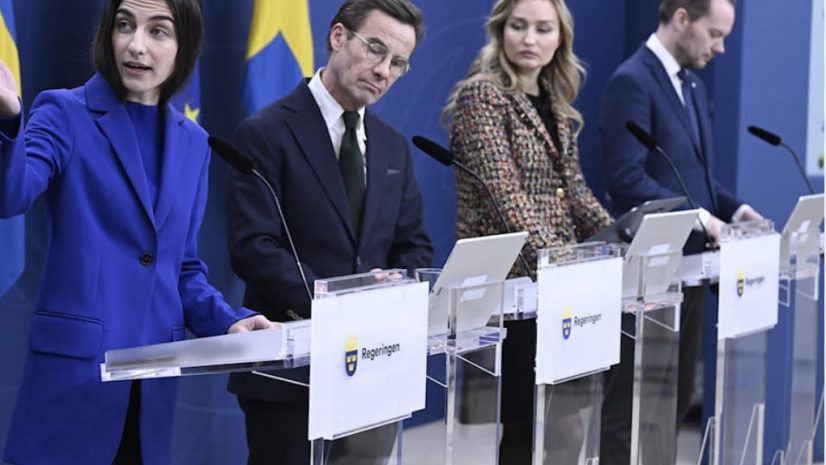
Reject the government proposal on serious peacetime crisis situations
I would like to appeal to all my colleagues in the Riksdag to vote against the government's proposal, which seriously risks undermining democracy when the government wants to give itself more power in crisis situations.
The bill 2024/25:155 on ”Serious peacetime crisis situations” is expected to give the government more power in a crisis situation. This could have devastating consequences for democracy if a broad parliamentary majority supports the government's proposal. The bill should therefore be rejected in its entirety
The new constitutional proposal in Chapter 16 of the Instrument of Government entails a concentration of power that could in practice become permanent - if a broad parliamentary majority so wishes.
The proposal does not define what a “serious peacetime emergency” means or what requirements must be met for something to be deemed a serious emergency. Natural disasters, terrorism or pandemics are mentioned among the motives, but there is no legal test in the constitutional text. This means that a parliamentary majority can arbitrarily classify, for example, a normal climate situation as a serious crisis, with far-reaching consequences for citizens' rights and freedoms.
The crisis authorisation has no automatic end time
The government can keep its extra powers as long as Parliament allows it - in theory for years. The only requirement is that it should end “as soon as it is not needed”. What is “needed” is decided politically, not legally.
In addition, the Riksdag can, by means of an authorisation act (section 2), authorise the government to issue ordinances in areas that normally require legislation. There is no requirement for a maximum period - as long as the majority wants, it can go on. This creates scope for far-reaching regulations without clear limits.
Even the so-called “emergency track” (section 3) has weak bars. While regulations may only be valid for three months and require 3/4 support, new decisions can be taken again and again. Alternatively, move to section 2 and give the government broad tools. There are no legal barriers to this.
Judicial review only takes place ex post, in specific cases. Sweden lacks a constitutional court. Moreover, experience shows that Swedish courts rarely convict the state, which makes control toothless. Personal liability for ministers is in practice non-existent.
We need to ask ourselves a number of key questions:
Can references to climate change be classified as a crisis under the proposal? Answer: YES.
Can ”lockdown rules” roll on for years? Answer: YES.
Could it open the door to coercive measures such as compulsory vaccination? In practice, the answer is YES to this question as well - as long as proportionality and necessity are deemed to be met by Parliament. The Patient Act's consent requirement is not sufficient in itself as a barrier if Chapter 16 is activated.
The bill explicitly states that when 16:1 is activated and the government uses the 3 § track (emergency mode), it may issue regulations in the field of law that may, if necessary, for example, derogate from or supplement existing legal provisions.
This means that a temporary emergency regulation can override e.g. the Patient Act consent rule for a limited time - provided 3/4 support in Parliament.
The Patients Act (Chapter 4, Section 2) states: Health care may not be provided without the patient's consent, subject to this or any other law. Normally “law” = parliamentary law, not regulation.
However, Chapter 16 of the Bill gives the Government constitutional authority to temporarily regulate what would otherwise have to be written in law - and the proposal clarifies that such provisions may derogate from the law. Thus, the main rule of the Patients Act alone cannot be invoked as a stumbling block if Chapter 16, Section 3 is used correctly.
The proposal lacks protection against abuse where everything is based on the good will of Parliament. It is not enough. In a country where cross-party consensus is more the rule than the exception, the 3/4 requirement is no guarantee - you only have to look at the NATO or WHO examples for this to be obvious to all.
We in Ambition Sweden (A) believe that this change should not happen at all. But if the constitution is to be changed, protections must be strengthened:
- Time lock of the crisis state (e.g. 30 days).
- Narrow and concrete definition of “severe crisis”.
- Ceiling and time limits for authorisations.
- Constitutional bar to long-term restrictions on liberty.
- Impartial preliminary examination by the Constitutional Court.
- Without this, the door is opened to permanent states of emergency - completely contrary to the essence of democracy. The proposal should be rejected.
The amendments are proposed to enter into force on 1 January 2027.
https://share.google/m6FQZn97iiNyAMpVg
Member of Parliament and Party Leader, Ambition Sweden (A)